Finance
What Nobody Tells You About Getting Your Finances Together in Your 20s and 30s

What Nobody Tells You About Getting Your Finances Together in Your 20s and 30s
Your 20s and 30s are when money starts to feel personal. Rent jumps. Friends start buying houses. Someone you went to high school with is talking about their brokerage like it’s a personality. Meanwhile you’re staring at a student loan and a grocery bill that looks like a car payment.
Here’s what people skip when they give “just start investing” advice.
Almost nobody has it as figured out as they look
The couple with the nice kitchen? One of them might be carrying $18,000 on a card. The guy flexing travel photos? Points, roommates, or parents. Comparison is a silent budget killer because it makes you spend like your highlight-reel version of someone else’s life.
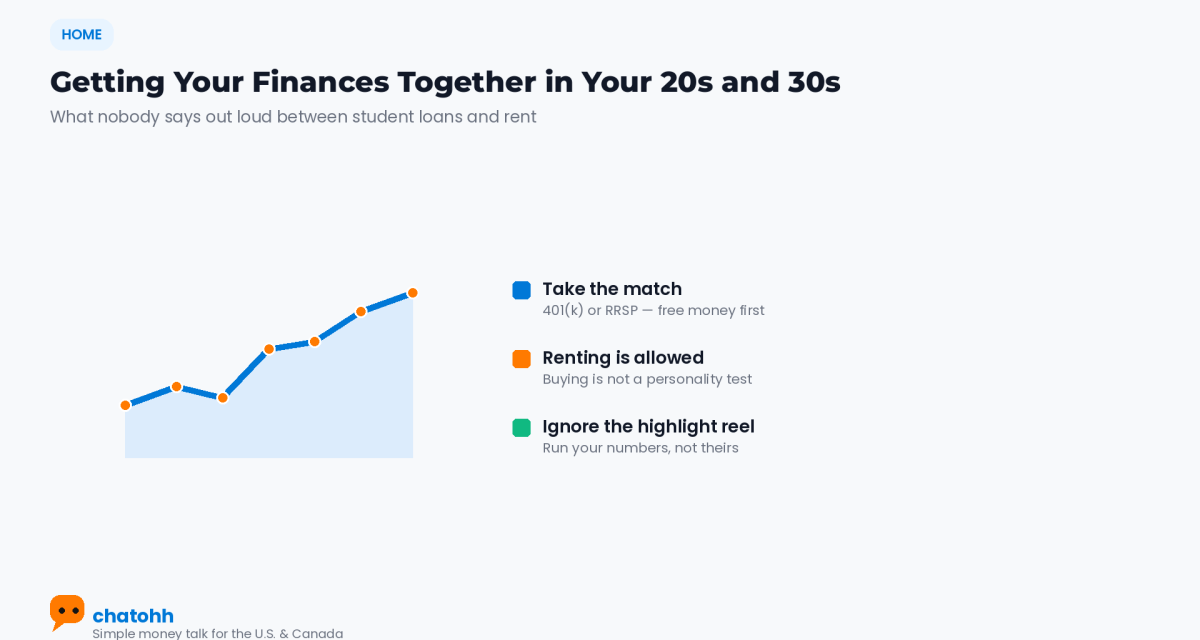
Run your own numbers. Not theirs.
Your first “real” job will underpay you for a while. Act like it.
Entry-level salaries in a lot of U.S. and Canadian cities do not match rent. That’s not a you-problem only. It means lifestyle creep is deadly early. The raise you get at 26 will disappear if the car, the apartment, and the weekend plans all upgrade the same week.
Bank the raise for three months before you spend any of it. If you can live on the old number, the new number becomes savings, debt payoff, or a move later — not a newer phone.
Student loans are loud. High-interest cards are louder.
Federal student loans in the U.S. and government student loans in Canada are annoying. They are usually not 24% APR annoying. If you’ve got both, the card is the fire. Income-driven plans, repayment assistance, and refinancing are tools — not a personality test. Read the terms. Don’t freeze.
The 401(k) match is the easiest raise you will ever get
If your job puts in 50 cents or a dollar for every dollar you put in, up to a cap, take it. That’s an instant return you will not get picking stocks at lunch. Canadians: if your employer has an RRSP match or a group RRSP, same idea. Free money first. Heroics later.
You do not need to max the thing at 24. You need to not leave the match on the table while you “figure out investing.”
Renting is not a moral failure
Homeownership can be great. It can also trap you in a city you hate with a roof that leaks and a rate that made sense on paper. In 2026, a lot of first-time buyers still need a solid down payment, closing cash, and a payment that works at today’s rates — not 2021 rates.
If buying would wipe your savings and stretch you past 35% of take-home, renting and investing the difference is not “throwing money away.” It’s staying solvent.
Your 30s get expensive in ways Instagram doesn’t show
Kids, weddings, aging parents, a back that needs physical therapy, a dog with a vet bill. The people who look calm in their 30s usually started a boring system in their 20s: automatic savings, no lifestyle that requires overtime forever, and a credit file that isn’t a dumpster fire.
You can start that system late. Plenty of people do. You just can’t start it “next year” forever.
A boring decade beats a chaotic one
The flex in your 20s and 30s is not looking rich. It’s being able to change jobs, leave a bad roommate, or handle a layoff without calling your parents in a panic. That flexibility is the real prize. Build toward that, not toward a kitchen that photographs well.
A 20-minute setup for this age
List your loans and rates. Turn on 401(k) or RRSP match if it’s off. Set one automatic transfer, even $20. That’s a better decade-starter than a new budgeting personality.
If friends are buying houses on family money, you are not late. You are on a different balance sheet. Stay in your lane long enough for compound interest and raises to show up. They are slow. They are still real.