Buying Home
The Only Money Rules That Actually Matter When You’re Just Trying to Get By

The Only Money Rules That Actually Matter When You’re Just Trying to Get By
Scroll money Twitter for ten minutes and you’ll think you need a family office, a tax lawyer, and a morning routine that starts at 4:30 a.m. You don’t. If you’re just trying to keep the lights on and stop feeling sick on the 27th of the month, you need a short list.
Here are the rules that actually move the needle. Everything else is optional until these are in place.
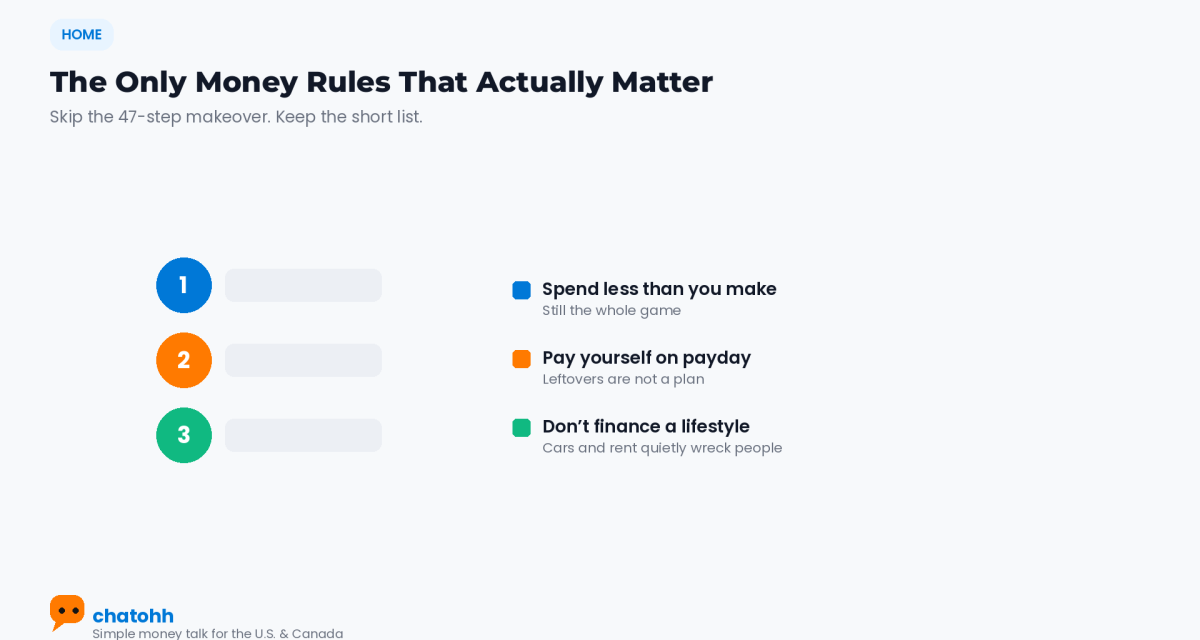
Rule 1: Spend less than you make. Yes, still that.
It’s not cute. It’s also not optional. If money leaves faster than it shows up, no app, side hustle, or “abundance mindset” fixes that. Track one month. If the gap is ugly, cut the easy stuff first: unused subscriptions, delivery fees, the extra car you don’t need.
You don’t have to live on rice and beans. You do have to stop pretending a $14 lunch every weekday is “not a big deal.” That’s a car insurance payment.
Rule 2: Keep a cash cushion so life doesn’t become a credit card event.
A $400 surprise is not an emergency if you have $1,000 sitting in a high-yield savings account. It is an emergency if that $400 goes on a card at 22% APR and you minimum-pay it for two years.
Start with $1,000. Then work toward one month of bills. Then three. Don’t skip straight to “six months of expenses” if that number makes you shut the laptop. Small and real beats big and imaginary.
Rule 3: High-interest debt gets extra money before almost anything else.
A 401(k) match is still free money — grab that. After the match and a starter emergency fund, extra cash should go at credit cards and payday-type loans. Those rates eat raises for breakfast.
Student loans and a mortgage are usually a different animal. Don’t treat a 6% mortgage like a 24% store card. Know the rate. Attack the ugly one.
Rule 4: Pay yourself on payday, not on leftovers.
If savings is “whatever is left,” savings is $0. Automate a transfer the morning the direct deposit lands. $20. $50. $200. The number matters less than the habit. Future-you should not have to be disciplined at 11 p.m. on a Thursday.
Rule 5: Know your credit like you know your Wi-Fi password.
Your score affects the rate on a car, an apartment deposit, sometimes even a job screen. In the U.S., pull AnnualCreditReport.com once a year. In Canada, check Equifax and TransUnion. Fix errors. Keep utilization under about 30%, ideally under 10%. Pay on time. That’s most of the game.
Rule 6: Don’t buy a lifestyle you only like on Instagram.
New car smell is expensive. So is a wedding that takes three years to pay off. So is moving into an apartment that needs your entire paycheck plus a roommate’s good mood. Housing and cars are where regular people quietly go broke while telling themselves they “earned it.”
A rough guardrail: keep housing (rent or PITI — principal, interest, taxes, insurance) from swallowing your whole life. If the payment only works when nothing goes wrong, it does not work.
Rule 7: Invest after the fire is out, not during it.
Index funds are great. They are not a substitute for a checking account that hits zero on the 19th. Get the match. Then get stable. Then invest on a schedule. You do not need to pick stocks. You need time in the market and a contribution that happens whether you feel motivated or not.
That’s the list. Not 30 rules. Not a guru’s course. Spend less than you make, keep cash, kill expensive debt, automate, watch your credit, don’t stretch housing and cars, then invest. Do those and you’re already ahead of a lot of people who own a lot of books about money.
How to use the rules without turning them into homework.
Put the seven rules in your notes app. Once a month, grade yourself pass/fail. Not 1–10. Pass/fail. If you spent less than you made, kept a cushion, and didn’t miss a payment, you passed. Everything else is extra credit.
Couples: pick one shared checking for bills and one shared savings for the cushion so you’re not running two sets of rules that fight each other. Money fights are often two budgets pretending to be one household.