Finance
Start Investing from $99: A Simple Plan That Actually Works

Start Investing from : A Simple Plan That Actually Works
You can start investing from $99. Not after a raise. Not after you “learn the market.” This week, with money that would otherwise vanish into takeout.
A lot of people wait because they think investing starts at a thousand bucks and a finance degree. Brokers killed that story. Fractional shares mean $99 buys a slice of a whole-market fund. The hard part is not the math. The hard part is opening the account and hitting buy once.
This is the simple version for the U.S. and Canada. No day trading. No “hot ticker.” Just a first $99 that can sit and grow.
What is (and is not) allowed to do
Ninety-nine dollars will not retire you. It will not fix a 22% credit card. It will buy a slice of the market and teach your hands the motion: transfer, buy, leave it alone.
That motion is the whole skill. People who begin with $99 and repeat it on payday beat people who read charts for a year and never fund an account.
What $99 cannot do: erase high-interest debt. Replace an emergency fund. Survive as grocery money you might need on Thursday. If the $99 is rent, stop. If it is leftover after bills and a tiny cash cushion, keep reading.
Do this before you start investing from
Three filters. Skip them and the first dip will send you to the card.
- A starter cash cushion — even $500 to $1,000 in a high-yield savings account so a flat tire is not a fire sale
- No new charges on a high-APR card you cannot clear this month
- The workplace match, if you have a 401(k) or group RRSP — that free money still beats a random $99 ETF
If those three are ugly, put the $99 toward the cushion or the card first. Investing is step four, not step one. We already walked through that order in Stop Overcomplicating Money and How Much Should You Actually Invest Each Month.
How to start investing from this week
Here is the boring checklist. Do it in one sitting if the apps cooperate.
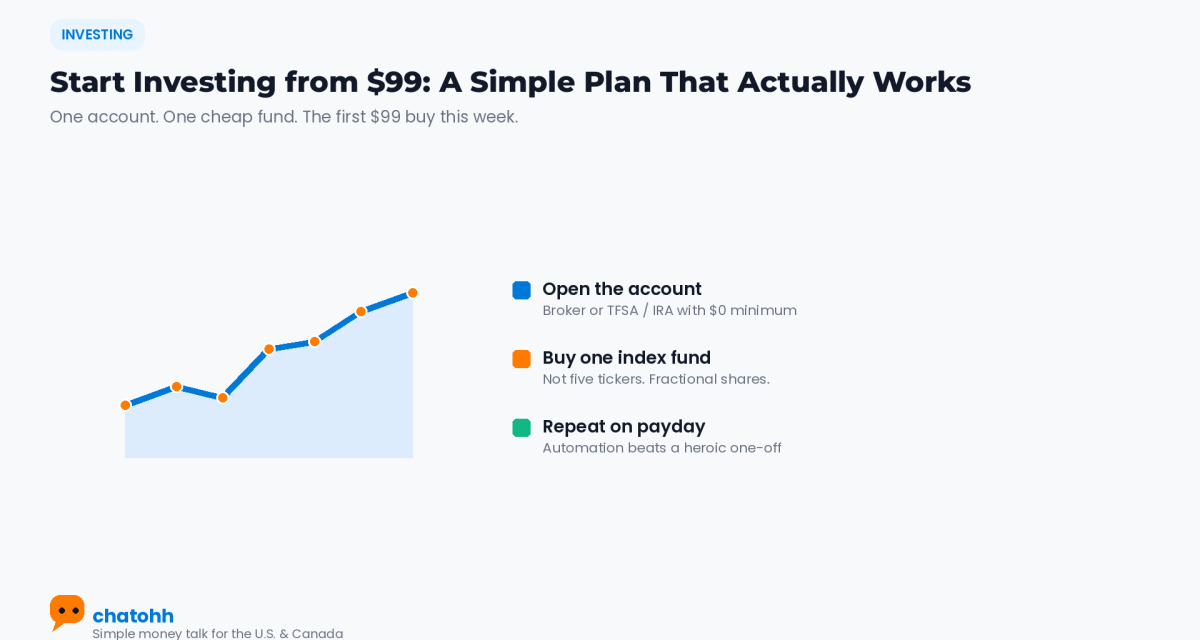
- Pick a real brokerage or the investing side of a bank you already trust — $0 account minimum, $0 stock/ETF commissions, fractional shares
- Open the right wrapper: a regular brokerage or Roth/traditional IRA in the U.S.; a TFSA (or RRSP) in Canada
- Turn on two-factor login. Write down the beneficiary if the form asks
- Link checking. Transfer $99. Wait for it to settle if you have to
- Buy one broad fund. Not five tickers. One
- Set a repeating transfer — $25, $50, or another $99 on payday — so this is not a one-off dare
That is the whole week-one job. The account is the project. The fund is a default.
Where a start goes in the U.S. vs Canada
United States
Most big brokers now let you open with $0 and buy fractional shares from about $1. Fidelity, Schwab, and Vanguard are the usual “I want this to still exist in 20 years” names. $0 online commissions on U.S. stocks and ETFs is normal in 2026.
If work offers a 401(k) match, fund that first. Then use an IRA or a plain brokerage for the extra $99. Roth vs traditional is a tax-timing choice, not a personality test. IRS and DOL pages explain the wrappers. We mapped them in 401(k), IRA, TFSA, RRSP — What to Use.
Canada
A TFSA is the friendly first bucket for a small start. Growth and qualifying withdrawals are tax-free, and you get the room back the next year after you take money out. An RRSP is better when you need the deduction this year and you will not raid it. Wealthsimple-style apps and Questrade-style shops both let small accounts buy ETFs. Watch FX fees if you keep buying U.S.-listed funds in Canadian dollars.
Confirm contribution room on the CRA site before you pack a TFSA like it has no ceiling. Over-contributing is a rude penalty.
What to buy with the first
Buy a broad index fund or ETF. Total U.S. market, S&P 500, or an all-in-one “asset allocation” / target-date fund. Canadians often use an all-in-one ETF that already mixes Canadian, U.S., and international stocks plus bonds.
The SEC’s Investor.gov page on index funds is the clean explainer if you want the official version, not a YouTuber. Low expense ratio. No leverage. No single-stock crush.
Do not pick five companies you like. Do not buy the coin your group chat named. A $99 stock pick is a lottery ticket with extra steps. We already made that case in Don’t Pick Stocks.
One fund. Repeat purchases. That is the portfolio until the account is big enough to rebalance, and even then many people just keep the one all-in-one fund.
How to not sabotage a start
The market will have a red month. Maybe a red year. If you buy once and then sell the first time the number shrinks, you practiced quitting, not investing.
Write the rule now: I do not sell the index fund for a headline. I keep the automatic buy. I only use savings for emergencies. If a 10% drop would make you throw up, read Investing When You’re Scared and keep more cash on the side. Fear is information. It is not a reason to earn 0.01% forever.
Fees still matter at $99. A $5 trading commission on a $99 buy is a 5% haircut before the market does anything. Use $0-commission ETF trades. Skip mutual funds with $1,000 or $3,000 minimums. The ETF version of the same idea usually lets a $99 buy go through with fractional shares.
Check the expense ratio. Under 0.10% on a broad fund is common and fine. A 1% annual fee is a silent roommate.
A 30-day plan after you start investing from
- Day 1: account open, $99 in, one fund bought
- Day 2: automatic payday transfer turned on — even $25
- Day 7: two-factor and beneficiaries confirmed
- Day 30: look at the balance once. Do not tinker. Raise the transfer if a bill died
If you want the official homework, use Investor.gov’s compound interest calculator and see what boring monthly adds do over 10 and 20 years. The number is not a promise. It is a reason to stop waiting for a prettier starting amount.
You do not need a new personality to begin. You need an account, one cheap fund, and a transfer that happens when you are tired. Do the first buy. Let next payday do the second.