Finance
How Regular People in the U.S. and Canada Are Quietly Getting Ahead

How Regular People in the U.S. and Canada Are Quietly Getting Ahead
The people getting ahead in 2026 are rarely the loudest ones. They’re not posting laptop photos from Bali. They’re the nurse who maxes the match, the welder who refinanced nothing he didn’t understand, the teacher couple who kept the old cars and funded the TFSA or the Roth.
Quiet money looks like this.
They treat payday like a split, not a shopping trip
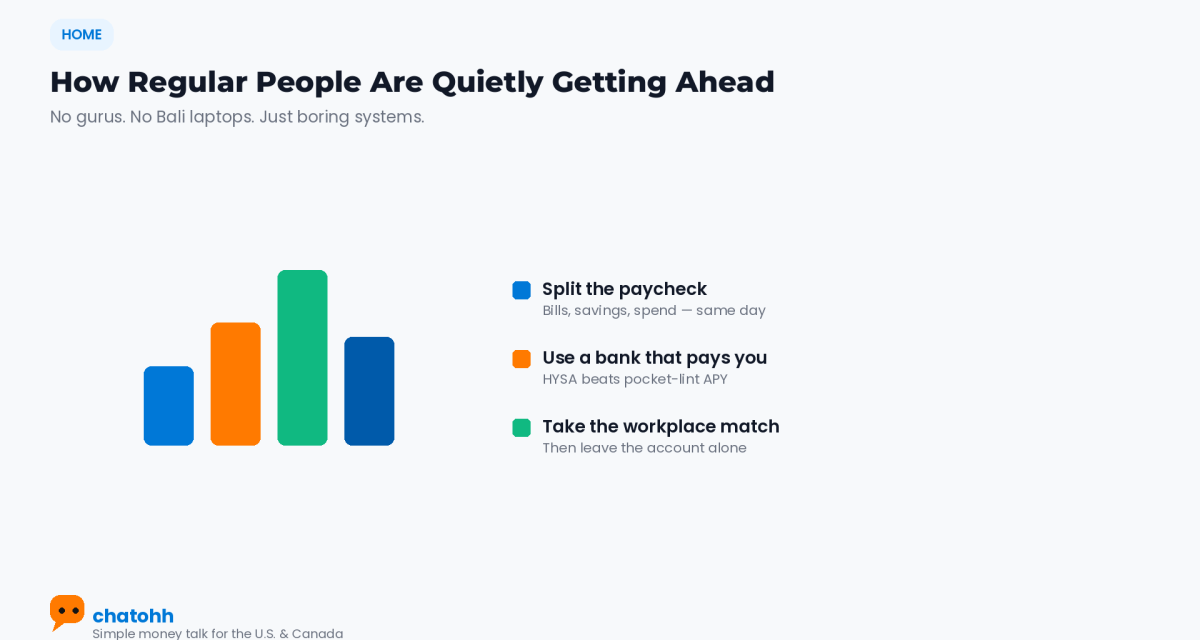
Direct deposit lands. Bills, savings, debt extra, and spendable cash get separated the same day. They don’t “see how the month goes.” The month already has a plan. That’s why they still have money on the 29th and you feel hunted by Venmo requests.
They use banks that pay them
A checking account at a giant bank paying almost nothing is a habit, not a strategy. Regular people who get ahead park emergency cash in a high-yield savings account in the U.S. or a high-interest savings account in Canada. Same money. Better yield. Still liquid.
They are not chasing the absolute top rate every week. They are not leaving five grand in an account that pays 0.01% because “that’s my bank.”
They don’t finance a personality
A truck payment, a designer bag on Klarna, a wedding that needs a payment plan — that’s lifestyle debt dressed up as “you only live once.” The folks getting ahead still live. They just don’t borrow 22% to look like they live bigger.
They buy used cars more often than people admit. They keep phones for four years. They say no to the destination bachelor party without writing an essay about it.
They take the free money at work
Employer match on a 401(k), 403(b), or group RRSP is the closest thing to a raise that doesn’t ask you to work Saturdays. The people getting ahead put in at least enough to get every matching dollar. Then they leave it alone.
They pick a target-date fund or a simple index mix and they do not log in every time the market has a mood.
They buy houses they can actually hold
Not the biggest house the lender will approve. The house whose payment still works if overtime dries up or one income pauses. In both the U.S. and Canada, stretching for a mortgage that only works on paper is how “getting ahead” turns into “one repair away from trouble.”
Down payment, closing costs, moving, and a repair fund are part of the price. If the spreadsheet only works without those, the spreadsheet is lying.
They keep insurance boring and current
Renters insurance. Term life if somebody depends on their paycheck. Disability if their job is their only asset. They shop car insurance every year because loyalty is not a discount. They don’t skip coverage to afford a nicer monthly lifestyle. That’s backwards.
The pattern is not secret
Split the paycheck. Earn yield on cash. Don’t borrow for status. Take the match. Buy a house you can keep. Insure the stuff that would wreck you. Do it for a decade. That’s how regular people get ahead while other people wait for a windfall that is not coming.
You can start this month. No rebrand required.
Copy the quiet parts, not the kitchen
This week, pick one quiet habit: split the next paycheck, move cash to a HYSA, or raise the workplace contribution by 1%. One. The people who look calm usually stacked boring moves, not one cinematic year.
If your job has a match you’re not taking, that is the first copy-paste. Everything else can wait a month. Free money first, aesthetics later.